
On this page
- Why choose copper?
- How does copper weather here?
- Copper compared
- How are copper gutters installed?
- Runoff and staining
- Terms you will hear
- Questions to ask
- Copper gutters at a glance
- Where copper gutters matters around Chesapeake
- A first step worth taking
- Looking after copper
- Copper costs in context
- Copper and the historic look
Why choose copper?
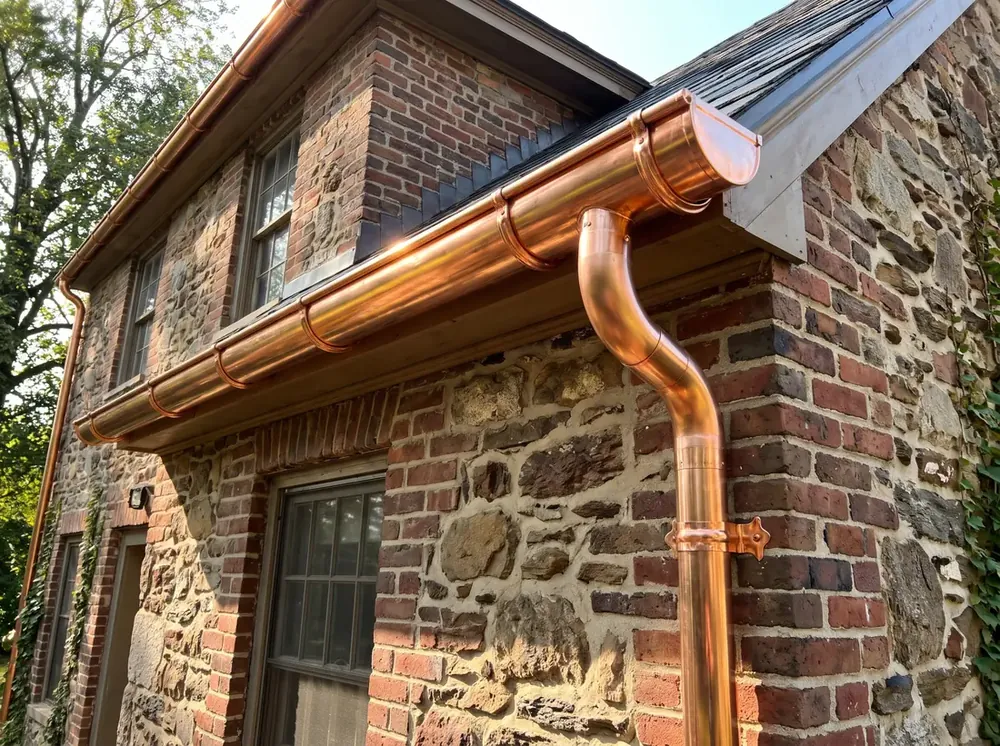
- Life span. Copper does not rust, which matters in humid air near tidal water.
- Strength. Heavier copper holds its shape well under wet debris.
- Looks. It suits brick, stone and traditional houses and ages without paint.
- Fit with period homes. On an older house in South Norfolk, copper half-round can match the style.
The trade-off is cost. National guides put copper at roughly $25 to $40 a foot installed, according to This Old House, several times aluminum.
How does copper weather here?
New copper is bright. Over months it darkens to brown, and over years it develops the green patina seen on old copper. Moisture speeds that process, so in a humid, coastal place like Chesapeake the change tends to come sooner than in dry inland climates. Some owners treat new copper to keep it bright; most let it weather.
Copper compared
| Feature | Copper | Aluminum | Galvalume steel |
|---|---|---|---|
| National price per foot installed | About $25 to $40 | About $9 to $18 | About $6 to $14 |
| Life span | Longest | Long | Long, if the coating holds |
| Rust in damp air | Never | Never | Possible where scratched |
| Paint | None needed | Factory finish | Factory finish |
| Seams | Usually soldered | Sealed and riveted | Sealed and riveted |
Aluminum and steel ranges are national figures from Angi and This Old House.
How are copper gutters installed?
- Profile: half-round is traditional; K-style copper is also available.
- Weight: 16 oz for most houses, 20 oz for larger gutters.
- Joints: usually soldered.
- Hangers and straps: copper or compatible metals only.
- Expansion: long runs need expansion joints.
- Downspouts: usually round copper.
Runoff and staining
Water off copper can leave blue-green stains on light brick, concrete and siding below. Sending downspouts to gravel, splash blocks or buried lines limits that.
Terms you will hear
| Term | What it means on a Chesapeake house |
|---|---|
| Half-round gutter | A semicircular trough hung in round brackets, seen on some older houses such as those in South Norfolk and often made in copper. |
| Patina | The brown and then green layer that forms on copper as it weathers. |
| Bracket hanger | A curved support that holds a half-round gutter from beneath and screws to the fascia. |
| Gauge | Metal thickness. Aluminum gutter is commonly .027 or .032 inch; the thicker coil dents less from limbs and ladders. |
| Downspout | The vertical pipe, also called a leader, carrying water to the ground. Common sizes are 2x3 and 3x4 inches. |
| Galvalume | Steel coated with an aluminum and zinc alloy. Stiffer than aluminum, but a scratch through the coating can rust in salty, damp air. |
Questions to ask
- 16 oz or 20 oz copper, and why?
- Half-round or K-style, and what size for this roof?
- Are seams soldered?
- What hangers and fasteners will be used?
- How will staining below the downspouts be avoided?
See also half-round gutters and the metals guide.
Copper gutters at a glance
| What people ask | Short answer |
|---|---|
| Typical weight? | 16 oz; 20 oz for larger gutters |
| How are joints made? | Usually soldered |
| Fasteners? | Copper or compatible metals only |
| Staining? | Possible on light brick and concrete below |
Where copper gutters matters around Chesapeake
| Neighborhood or town | Why it comes up there |
|---|---|
| South Norfolk | Restorations of early twentieth-century houses |
| Fentress | Historic farmhouses in the district |
| Portsmouth | Older Olde Towne homes |
A first step worth taking
Ask for a sample of the copper and hangers before signing, and ask how downspout water will be kept off light brick or concrete.
Looking after copper
Copper needs little care beyond cleaning. Clear debris by hand or with a soft scoop, since scraping tools mark the surface. Check soldered joints every few years and after big storms; a cracked joint can be resoldered. Keep other metals away: an aluminum ladder stabilizer or a steel screw left in contact can corrode over time. If a copper roof or flashing drains onto aluminum gutters, plan the change of metal carefully, because the runoff itself can attack aluminum.
On older houses, copper often outlasts the wood it is fixed to, so check the fascia whenever the gutters are cleaned.
Copper costs in context
At about $25 to $40 a foot installed nationally, copper on a 150-foot house runs roughly $3,750 to $6,000 for the gutter alone, before downspouts and extras. That is several times aluminum. Owners who choose it usually do so for looks and life span on a house they plan to keep.
Copper and the historic look
On older houses, copper half-round can echo the original roof details. Inside historic areas, check with the city before changing visible materials.