
On this page
- Side by side
- How does Chesapeake's air affect each metal?
- How do they handle storms?
- Aluminum thickness
- What about vinyl?
- Mixing metals
- Terms you will hear
- Gutter metals at a glance
- Where gutter metals matters around Chesapeake
- A first step worth taking
- Which metal for which building?
- Life span compared
- Color and looks
- A simple way to choose
- Downspouts to match
Side by side
| Feature | Aluminum | Galvalume or galvanized steel | Copper |
|---|---|---|---|
| National price per foot installed | About $9 to $18 | About $6 to $14 | About $25 to $40 |
| Rust | No | Where coating is damaged | No |
| Stiffness | Medium; .032 better | High | Medium to high |
| Weight | Light | Heavier | Heavy |
| Colors | Many | Several | Natural, weathers to patina |
| Seamless forming | Yes | Yes, with the right machine | Yes, or sectional with solder |
| Best fit | Most houses | Barns, outbuildings, some commercial | Period and custom homes |
Prices from Angi and This Old House.
How does Chesapeake's air affect each metal?
Chesapeake has a humid subtropical climate, classed Cfa in the Wikipedia summary, and sits on tidal water: the Elizabeth River's branches and the Intracoastal Waterway run through the city. Damp, salt-tinged air is hard on steel wherever its coating is scratched or cut. Aluminum does not rust, though bare scratches can show white oxidation. Copper does not rust either; it darkens and slowly develops a green patina, usually faster in moist air.
How do they handle storms?
Wind and falling limbs are the main storm risks. Hurricane Isabel brought down thousands of trees across Virginia, according to Wikipedia. Steel resists dents best; .032 aluminum and heavy copper also hold their shape far better than thin aluminum. Whatever the metal, hanger type and spacing matter more than the metal itself in wind.
Aluminum thickness
| Thickness | Use |
|---|---|
| .027 inch | Sheltered single-story runs, budget jobs |
| .032 inch | Wooded lots, exposed houses, 6-inch gutters |
What about vinyl?
Vinyl sectional gutters are sold for DIY. They do not rust, but they come in short sections with many joints, and they can become brittle and sag over time. In a climate with heavy rain and strong storms, most contractors recommend seamless metal.
Mixing metals
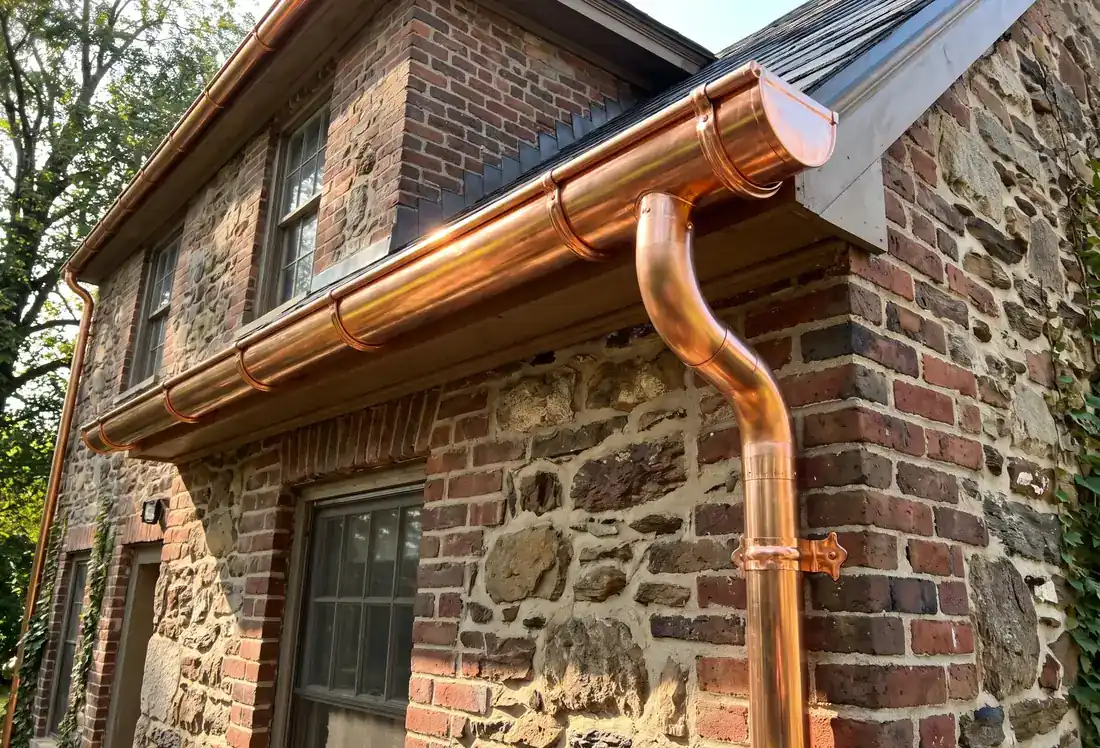
Copper in contact with aluminum or galvanized steel causes galvanic corrosion of the other metal. Copper gutters need copper or compatible hangers, straps and fasteners. Water running off a copper roof onto aluminum gutters can cause the same problem.
Terms you will hear
| Term | What it means on a Chesapeake house |
|---|---|
| Galvalume | Steel coated with an aluminum and zinc alloy. Stiffer than aluminum, but a scratch through the coating can rust in salty, damp air. |
| Gauge | Metal thickness. Aluminum gutter is commonly .027 or .032 inch; the thicker coil dents less from limbs and ladders. |
| Patina | The brown and then green layer that forms on copper as it weathers. |
| Coil stock | The roll of pre-finished aluminum, steel or copper that feeds the seamless gutter machine. |
| Seamless gutter | Gutter rolled out of a coil on site into one piece for each wall, so the only joints are at the corners and ends. |
| Half-round gutter | A semicircular trough hung in round brackets, seen on some older houses such as those in South Norfolk and often made in copper. |
See aluminum gutters and copper gutters.
Gutter metals at a glance
| What people ask | Short answer |
|---|---|
| Most homes? | Seamless aluminum |
| Strongest? | Steel |
| Longest life? | Copper |
| Avoid? | Mixing copper with aluminum or galvanized steel |
Where gutter metals matters around Chesapeake
| Neighborhood or town | Why it comes up there |
|---|---|
| Western Branch | Damp riverside air |
| South Norfolk | Older houses where copper can suit |
| Pleasant Grove | Barns where steel is common |
A first step worth taking
Ask each contractor which metal and thickness they recommend for your house and why. The reason matters more than the label.
Which metal for which building?
| Building | Usual metal |
|---|---|
| Suburban home | .032 aluminum |
| Older or period home | Aluminum or copper half-round |
| Custom home with brick or stone | Copper or dark aluminum |
| Barn or metal workshop | Steel or heavy aluminum |
| Commercial building | Heavy aluminum or steel |
Life span compared
Life span depends on the install as much as the metal. Seamless aluminum in good coil, on hidden hangers and kept clean, commonly lasts 20 years or more. Steel lasts as long as its coating stays intact; once scratched, rust can start. Copper commonly lasts many decades, with joints and fixings needing attention first. In all cases, gutters that overflow, sag or hold debris wear out faster, so upkeep matters for every metal.
Color and looks
Aluminum offers the widest color range. Steel comes in fewer colors. Copper starts bright, then browns and eventually develops a green patina; on brick and stone houses that change is often part of the appeal.
A simple way to choose
If cost matters most, choose seamless aluminum in .032. If the gutters take knocks from limbs, ladders or equipment, consider steel or heavy aluminum, and plan to touch up scratches so rust does not start in damp air. If the house is older, brick or stone and you plan to keep it a long time, price copper and compare it with dark aluminum half-round, which gives a similar line at a fraction of the cost. Whatever you choose, ask for the thickness or weight on the quote.
Downspouts to match
Downspouts are normally the same metal as the gutters. Mixing metals at the outlet invites corrosion, so copper gutters get copper downspouts.