
On this page
- Why consider 6-inch gutters in Chesapeake?
- 5-inch or 6-inch?
- Which houses usually get 6-inch?
- How are 6-inch gutters hung?
- Is upsizing always the answer?
- Terms you will hear
- Questions to ask
- 6-inch gutters at a glance
- Where 6-inch gutters matters around Chesapeake
- A first step worth taking
- How much water does a roof send to the gutter?
- Hanger spacing for 6-inch
Why consider 6-inch gutters in Chesapeake?
Rain intensity. Chesapeake averages 48.4 inches of precipitation a year in the Wikipedia climate table, but gutters fail in the heaviest hour, not the average month. Tropical systems and summer thunderstorms are where 5-inch gutters run out of room. The National Weather Service reported more than 10 inches of rain in parts of the Tidewater from Hurricane Matthew in October 2016, and more than 10 inches in parts of southside Hampton Roads during a September 2016 storm.
The second reason is strength. A 6-inch gutter has a taller back and wider bottom, so it holds its shape better under wet debris and in wind.
5-inch or 6-inch?
| Feature | 5-inch K-style | 6-inch K-style |
|---|---|---|
| Relative capacity | Standard | About 40% more |
| Usual downspout | 2x3 or 3x4 | 3x4 |
| Stiffness | Lower | Higher |
| Looks best on | Smaller single-story houses | Two-story and larger houses |
| National price installed, aluminum | About $9 to $13 a foot | About $12 to $18 a foot |
Prices are national ranges from Angi.
Which houses usually get 6-inch?
- Two-story colonials and transitional homes with large upper roofs.
- Houses with valleys sending two slopes into one inside corner.
- Upper roofs that drain onto porch or garage roofs.
- Steep roofs that send water fast.
- Runs over about 40 feet with an outlet at one end only.
- Commercial and multi-unit buildings.
How are 6-inch gutters hung?
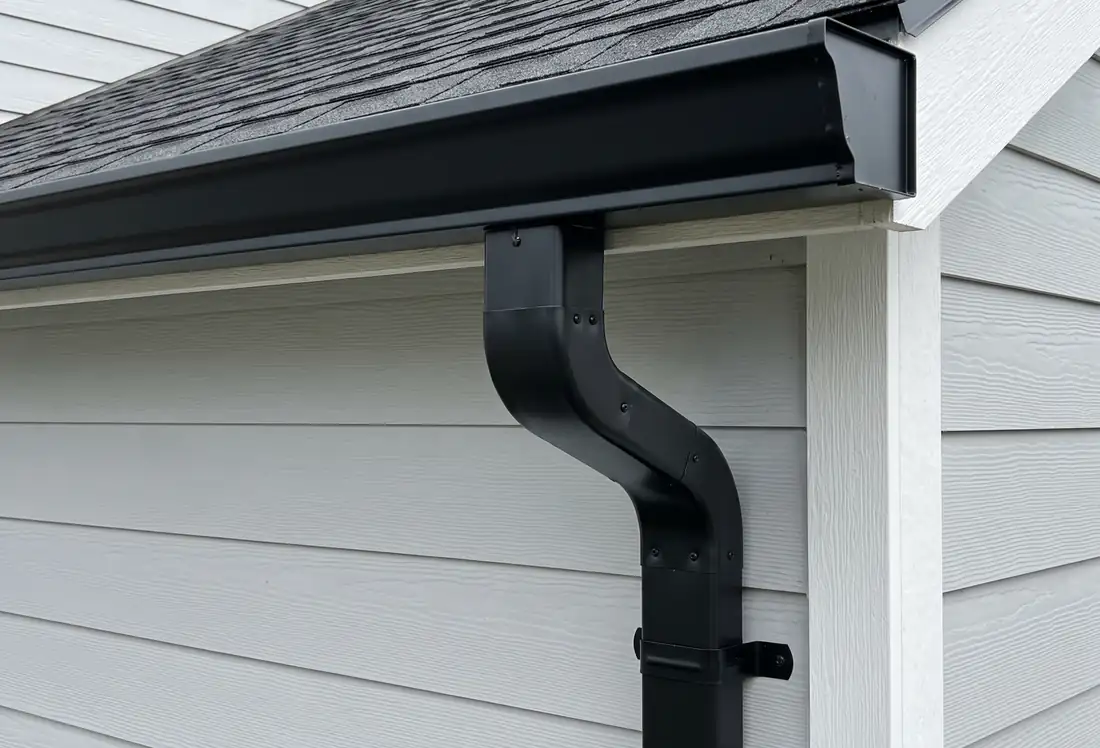
The same way as 5-inch, on hidden hangers screwed into sound fascia, though contractors often space them more closely because a full 6-inch gutter weighs more. A valley diverter at inside corners stops water from shooting past the front.
Is upsizing always the answer?
Not always. Adding an outlet halfway along a long run, going to 3x4 downspouts or adding a valley diverter can fix overflow without changing the whole gutter. See overflowing gutters.
Terms you will hear
| Term | What it means on a Chesapeake house |
|---|---|
| K-style gutter | The standard profile, flat-backed with a decorative ogee face. It carries more water than a half-round gutter of the same width. |
| Downspout | The vertical pipe, also called a leader, carrying water to the ground. Common sizes are 2x3 and 3x4 inches. |
| Gauge | Metal thickness. Aluminum gutter is commonly .027 or .032 inch; the thicker coil dents less from limbs and ladders. |
| Hidden hanger | A bracket that clips under the front lip of the gutter and screws through the back into the fascia, invisible from the street. |
| Valley diverter | A small metal fin in the gutter under a roof valley that stops a rush of water from shooting over the front. |
| Outlet | The opening in the gutter bottom where the downspout joins, usually with a riveted drop sleeve. |
Questions to ask
- Which runs do you recommend 6-inch for, and which can stay 5-inch?
- What thickness of aluminum?
- How many outlets, and 3x4 downspouts throughout?
- Do any valleys need diverters?
Read the 5-inch vs 6-inch guide for the full comparison.
6-inch gutters at a glance
| What people ask | Short answer |
|---|---|
| Main reason to choose them here? | Summer cloudbursts and tropical rain |
| Usual downspout? | 3x4 |
| Mix sizes on one house? | Yes; size each run |
| Need closer hangers? | Often, because full gutters weigh more |
Where 6-inch gutters matters around Chesapeake
| Neighborhood or town | Why it comes up there |
|---|---|
| Great Bridge | Two-story homes with valleys over garages |
| Hickory | Large new homes with complex roofs |
| Moyock | Big subdivision roofs on flat lots |
A first step worth taking
Next time it pours, walk around the house and note every place water comes over the front. Those runs are the first candidates for 6-inch.
How much water does a roof send to the gutter?
A useful rule: each inch of rain on 1,000 square feet of roof is about 620 gallons of water. A two-story Chesapeake house with 2,000 square feet of roof sheds about 1,250 gallons in a one-inch storm, and many times that in a tropical downpour. Most of it arrives in the heaviest few minutes. When a run has only one outlet and a valley above it, a 5-inch gutter can fill faster than it drains.
That is why contractors look at roof area per outlet, not just the house size, when choosing between 5 and 6-inch. Two runs on the same house can need different sizes.
Hanger spacing for 6-inch
Full 6-inch gutters carry a lot of weight in water and wet debris. Hidden hangers at about 2 feet, or closer under heavy trees and on exposed walls, keep them straight.