
On this page
- The core difference
- Why joints matter in Chesapeake
- Counting joints
- When might sectional make sense?
- Terms you will hear
- Seamless gutters at a glance
- Where seamless gutters matters around Chesapeake
- A first step worth taking
- Signs sectional gutters are near the end
- Cost over time
- Mixing the two
- Questions to ask a contractor
- The Chesapeake case for seamless
- What about corners?
- Seamless and guards
The core difference
| Feature | Seamless | Sectional |
|---|---|---|
| How it is made | Formed on site to the length of each wall | Bought in 10 or 20-foot pieces |
| Joints along a run | None | One at every connector |
| Leak points | Corners, ends, outlets | Same plus every connector |
| Debris catch | Few | Every connector lip |
| Installed by | Contractor with a machine | Contractor or homeowner |
| Common metals | Aluminum, steel, copper | Vinyl, aluminum, steel |
| Upfront cost | Higher per foot | Lower per foot |
Why joints matter in Chesapeake
Joints are sealed with sealant that has to cope with heat, water and movement. Chesapeake's hottest months, July and August, are also its wettest, at about 5.3 inches each in the Wikipedia climate table. A joint that bakes in the sun one afternoon and fills with storm water the next ages quickly. Multiply that by a connector every 10 feet and leaks are only a matter of time.
Connectors also catch debris. The lip of a slip joint inside the trough is a ledge where pine needles and catkins collect and start a dam.
Counting joints
A house with 160 feet of gutter in four runs might have:
- Seamless: about 4 corners and 4 end caps, so 8 joints.
- Sectional in 10-foot pieces: the same 8, plus about 12 connectors, so 20 joints.
When might sectional make sense?
- A shed, garage or outbuilding where a homeowner wants to do it themselves.
- A short repair to an existing sectional system.
- A very tight budget, accepting more upkeep.
Terms you will hear
| Term | What it means on a Chesapeake house |
|---|---|
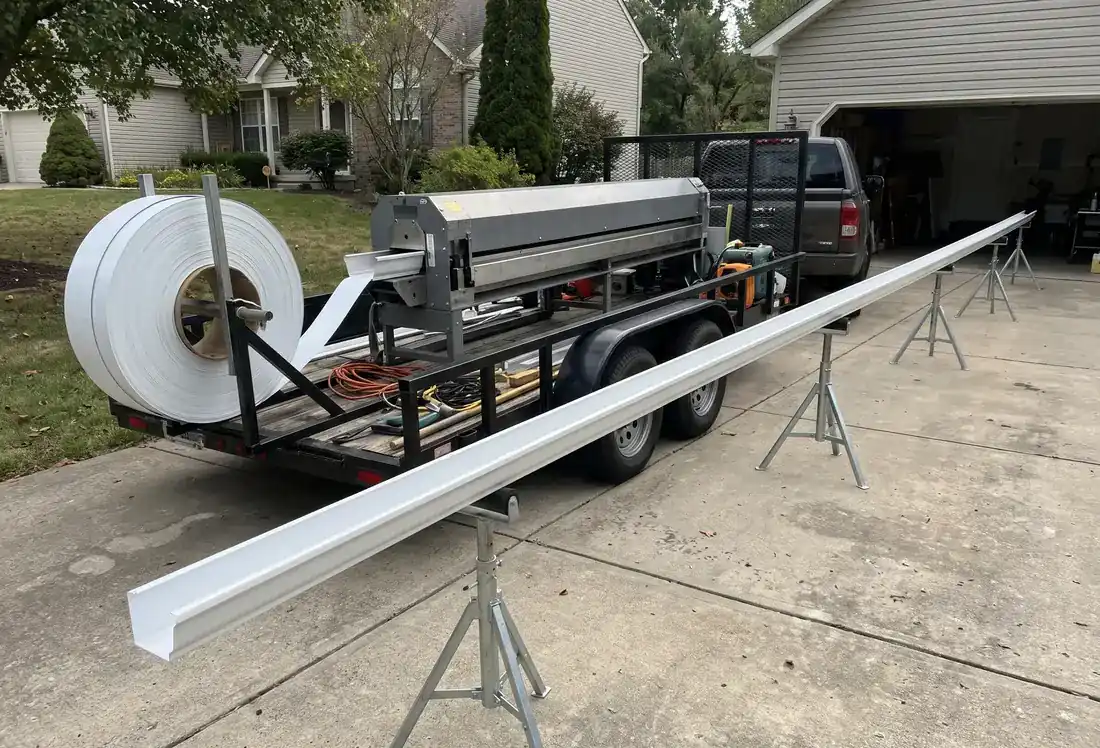
| Seamless gutter | Gutter rolled out of a coil on site into one piece for each wall, so the only joints are at the corners and ends. |
| Sectional gutter | Gutter sold in 10 or 20-foot lengths and joined with connectors. Every connector is another joint to leak. |
| Miter | The cut, riveted and sealed joint at an inside or outside corner, and the most common place for a leak. |
| End cap | The piece closing each end of a gutter run, crimped and sealed. |
| Coil stock | The roll of pre-finished aluminum, steel or copper that feeds the seamless gutter machine. |
| K-style gutter | The standard profile, flat-backed with a decorative ogee face. It carries more water than a half-round gutter of the same width. |
See seamless gutters and leaking gutters.
Seamless gutters at a glance
| What people ask | Short answer |
|---|---|
| Fewer leaks? | Yes, far fewer joints |
| DIY? | Sectional only |
| Long runs? | Seamless with expansion joints |
| Cost? | Higher up front |
Where seamless gutters matters around Chesapeake
| Neighborhood or town | Why it comes up there |
|---|---|
| Greenbrier | 1980s homes with original sectional gutters |
| Indian River | Older houses with leaking connectors |
| Hickory | Outbuildings where DIY sectional is common |
A first step worth taking
Count the connectors along your longest run. If there are several and any drip, price a seamless replacement for that run first.
Signs sectional gutters are near the end
- Drips at most connectors in heavy rain, even after resealing.
- Lines of algae or stain below each connector.
- Connectors pulled apart where the run has flexed.
- Debris caught at every seam.
- Sections sagging between hangers.
Once several of these show, resealing becomes a yearly chore. Replacing with seamless removes most of the joints in one job.
Cost over time
Sectional gutters cost less per foot to buy, and a homeowner can fit them. Over years, the connectors are what cost money: resealing, chasing drips and repairing the fascia those drips soak. Seamless gutters cost more up front but remove most of that upkeep. For a house you plan to stay in, seamless usually comes out ahead; for a shed or a short-term fix, sectional can be the sensible choice.
Mixing the two
It is possible to replace one sectional run with seamless and leave the rest, as long as the profile and color match at the corners. Many owners start with the worst side, usually the one with the most connectors or the run under a valley, and replace the rest later.
Questions to ask a contractor
- How many joints will the new system have, and where?
- Are corners factory-made or cut on site?
- Will long runs have expansion joints?
- What sealant is used at corners and ends?
The Chesapeake case for seamless
Heat, heavy rain and constant debris all work against joints. A connector that would last years in a dry, mild place faces long wet spells, hot sun and the weight of wet leaves here. That is why most contractors in humid coastal areas install seamless aluminum as standard, and why sectional systems on older houses so often leak at every seam. If you are replacing gutters anyway, the extra cost of seamless is usually recovered in fewer repairs.
What about corners?
Even seamless systems have joints at corners. Factory-made corners or carefully mitered, riveted and sealed ones last longest. Ask how the corners will be made.
Seamless and guards
Seamless runs give guards a smooth, continuous lip to clip to, without connector lips in the way. That makes for a neater, better-sealed guard install, especially on long runs under trees.